
Soccer is the world’s most popular sport. It is played and watched by millions of people in almost every country. But one common question people ask is: How many players are on the field during a soccer game? Knowing the answer is important for understanding how the game works.
In this guide, we will explain everything in simple terms. You will learn about the standard number of players, their roles, and how substitutions work. We will also look at smaller formats of the game, such as five-a-side and futsal. Whether you are new to soccer or just curious, this article will give you all the information you need. Soccer might seem complicated at first, but by the end of this guide, you will feel more confident about the game’s rules.
Standard Number of Players in Soccer

In most professional soccer matches, each team has 11 players on the field at the start of the game. This means there are a total of 22 players on the field during play. This rule applies to all official competitions, including the FIFA World Cup, the English Premier League, and other major leagues around the world.
Out of these 11 players, one is the goalkeeper. The goalkeeper’s main job is to defend their team’s goal. They are the only player allowed to use their hands, but only inside the penalty box. The other 10 players are known as “outfield players.” These players move around the field, passing the ball, defending, and trying to score goals.
If a team has fewer than seven players on the field due to injuries, red cards, or other reasons, the match cannot continue. This rule ensures fairness in the game. Playing with fewer players can be a big disadvantage, which is why teams avoid situations like red cards.
The standard 11-a-side rule has been in place for many years. It helps keep the game organized and exciting for both players and fans. While the exact positioning of players may change based on team strategy, having 11 players is the foundation of modern soccer.
Breakdown of Player Positions
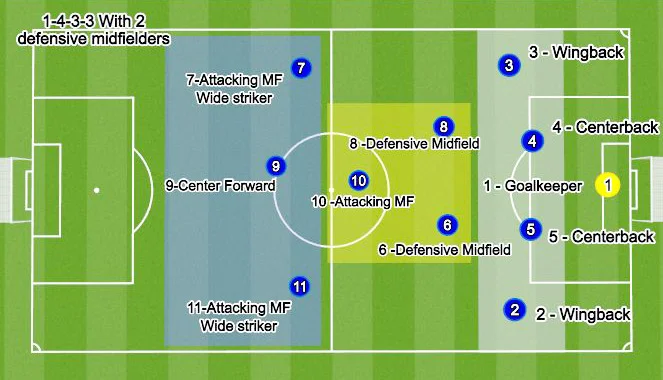
In soccer, the 11 players on a team are divided into different positions. Each position has a specific role to play. Here is a breakdown of the most common positions and their responsibilities:
1. Goalkeeper
- The goalkeeper is the last line of defense.
- They stay near the goal and block shots from the opposing team.
- Goalkeepers wear different-colored jerseys so they can be easily identified.
- They can use their hands, but only inside the penalty area.
2. Defenders
- Defenders are responsible for stopping the opposing team’s attacks.
- Most teams have 4 defenders.
- Types of defenders:
- Center-backs: They stay in the middle and clear the ball from dangerous areas.
- Full-backs: They play on the left or right side and often support the attack.
- Wing-backs: Similar to full-backs but focus more on attacking.
3. Midfielders
- Midfielders are the link between defense and attack.
- Most teams have 3 or 4 midfielders.
- Types of midfielders:
- Central Midfielders: Control the flow of the game.
- Defensive Midfielders: Help the defense by blocking opponents.
- Attacking Midfielders: Focus on creating chances to score.
- Wingers: Play along the sidelines and deliver crosses.
4. Forwards
- Forwards are the main goal scorers.
- Most teams have 2 or 3 forwards.
- Types of forwards:
- Strikers: Positioned closest to the goal to finish attacks.
- Second Forwards: Support the striker and create opportunities.
- Wide Forwards: Play near the sidelines and cut inside to score.
These positions work together to form the team’s tactics. Coaches decide how to arrange players based on the team’s strengths and weaknesses. For example, some teams may use a defensive formation with more defenders, while others prefer an attacking style with extra forwards.
Variations in Team Sizes Across Different Formats
Soccer is not always played with 11 players per team. There are several smaller formats of the game, each with its own rules and team sizes. Here are some popular variations:
1. Five-a-Side Soccer
- Played with 5 players on each team.
- Common in local leagues, training sessions, and casual games.
- The field is much smaller, and there are no offside rules.
2. Seven-a-Side Soccer
- Features 7 players per team, including a goalkeeper.
- Popular in schools and amateur competitions.
- Focuses on teamwork and skill.
3. Futsal
- Played indoors with 5 players per team.
- Uses a smaller, heavier ball.
- The game is fast-paced and emphasizes close control and quick passes.
4. Beach Soccer
- Played on sand with 5 players per team, including a goalkeeper.
- Known for its high-scoring and entertaining matches.
These smaller formats are great for players of all skill levels. They require fewer players, making it easier to organize games. They also allow players to improve specific skills, such as dribbling, passing, and shooting, in a more compact setting.
Substitutions and Squad Depth
Substitutions are a key part of soccer. They allow teams to replace tired or injured players during the game. In most professional matches, teams are allowed up to 5 substitutions. This rule was introduced recently to help teams cope with the physical demands of modern soccer.
Substitutions can only be made during stoppages in play, such as throw-ins, goal kicks, or injuries. Once a player is substituted, they cannot return to the game. This makes every substitution an important decision for the coach.
Squad depth is another crucial factor in soccer. It refers to the number of quality players available to a team. Teams with strong squad depth can handle injuries and fatigue better, especially during long tournaments like the FIFA World Cup or the UEFA Champions League. Having a deep squad also allows teams to rotate players and keep them fresh for important matches.
Historical Evolution of Team Sizes in Soccer
Soccer has not always been played with 11 players per team. In the early days, there were no fixed rules. Teams often had as many as 15 or 20 players on the field at once. This made the game chaotic and hard to follow.
The first set of official rules was introduced in 1863 by The Football Association (FA) in England. These rules limited teams to 11 players each. The reason for choosing 11 players is not entirely clear, but it may have been influenced by the size of cricket teams, which also have 11 players.
Over time, the 11-a-side format became the standard for professional soccer. It helped make the game more organized and enjoyable for players and fans. Today, the 11-player rule is used in almost all official matches, from local leagues to international tournaments.
Why Understanding Soccer Team Sizes Matters
Knowing how many players are on the field helps you understand the game better. It gives you insight into team strategies and tactics. For example, if a team is playing with fewer players due to a red card, they might focus more on defense to avoid conceding goals.
For new players, understanding team sizes is one of the first steps to learning soccer. It helps you know where to position yourself on the field and what your role should be. Watching games becomes more enjoyable when you can recognize different player roles and formations.
Even casual fans can benefit from this knowledge. When you watch a match, you will notice how each player contributes to the team’s performance. It also helps you appreciate the skill and teamwork required to play soccer at a high level.
Final Words
Soccer is a sport that is both simple and complex. At its core, it is an 11-a-side game with clear rules and roles. But the variations, strategies, and player dynamics make it endlessly fascinating.
Whether you are watching a professional match or playing a casual game, knowing the basics—like how many players are on the field—enhances your experience. With this guide, you now have a better understanding of soccer team sizes, positions, and formats. Next time you see a match, you’ll know exactly what to look for and why it matters.